Download this comprehensive guide book and Video Tutorial Today.
Testimonial
Check out this great Home Built Vibraphone from Chris!
"I found the build instructions excellent, with good back-up from Jim. I have managed to build a professional looking and sounding instrument for a fraction of the cost of a proprietry instrument and have had a lot of fun in the process."
Chris Burne
United Kingdom
Want a professional quality vibraphone, but don't want to pay the price of a commercial one?
You can build THIS one more easily than you might imagine, and for less than $700.
Dear fellow musician and enthusiast...
You have probably made it to this page because you want to have your own vibraphone, but are unwilling or unable to afford the large price tag.
Even a basic second hand one can cost a couple of thousand, let alone something new and high quality which can cost significantly more!
Available Instrument Building Guides
$73
$49.95
$39.95
$27
$9.95
$17
Package Deals
Well, I have a solution for you!
If you are the sort of person who is willing to put in a little personal effort, you can own a great set of vibes for less than $700 only,.. - and as a bonus, your knowledge of the instrument will be significantly increased.
You build it yourself using this comprehensive building guide & video instructions!
Got Questions?
Want to speak to me LIVE?
Contact me right now with Start Chat
or Voice Call
The Project V vibraphone on tour in schools
I know this might seem like a big task, or more than the average handyman can take on.... but this design is especially created for the beginner builder to tackle with only basic tools found in the average handyman's (or woman's) shed.
Of course if you have no experience building a musical instrument, you will have to follow the instructions carefully.... but these instructions are extremely clear and thorough, and many beginner builders have already used them with complete success.
... and if you have any questions at all for me after reading this page - you can simply email me or skype me using the buttons here to the right!
Imagine your personal satisfaction when performing on a quality instrument you built yourself.... and having such a great talking point in your home! And once you can practise vibes at home, your skills can progress so much faster!
This vibraphone was built by me specifically to be used on tour performing to schools. I wanted a low-cost instrument that was light and portable - sounded great - and could handle the knocks of three venues a day.
So.... let's compare the cost of building your own vibraphone, to buying one from a major music store...
Why Not Compare Prices Yourself From Some Major Suppliers?
The PV vibraphone is actually a pretty professional instrument. I took the prototype with me on tour in 2008 and performed FIFTY SEVEN shows in a row on it. It was in and out of vans and went from stage to stage without causing any hassles. It sounded great and the tour was a success! So now you can have a super budget price WITHOUT skimping on the quality!
And that's in Australia where our Aluminum is relatively expensive compared to the USA for example! Of course prices of individual items vary a little from place to place but you can see that building yourself is certainly going to save you money!
So of course the best option if you are a professional vibraphone player is usually the very best (read expensive) professional instrument you can buy. I would never recommend a lesser option as I know myself the value of excellent quality instruments.
but not all students or parents have this kind of money...
even schools prefer to spend it elsewhere...
...and I bet YOU would prefer to have that money for other things as well!
That is why I’ve created this solution for You
You make it Yourself - and it's much easier than you might imagine!
Check Out my Video " Compare the PV to a Musser Century Vibraphone
Look at those shiny polished bars!
You might think, this is too good to be true...
You might think, you really need special tools or materials...
You might think, it's only for people with good handyman skills...
I UNDERSTAND YOUR DOUBTS...
but this is a quality instrument, and the design is such that you can build it with fairly basic and common tools, using only stuff from the hardware store... and even a relatively inexperienced person in the workshop can build it!
For less than $700 and some of your own time, you can make a great set of vibes that will look fantastic & sound almost as good as a commercial one.... in fact it CAN sound JUST as goods as a commercial one if you use the same aluminum for the bars.
Will My Results Be The Same As Yours?
Obviously the instrument YOU build will depend on your own efforts, but the guide takes you through each step one at a time. In fact you can even make your own changes to suit your needs. Check out this great PV vibraphone build from Neil, who made some modifications to the frame design!
"Hi Jim. This is my finished Vibraphone.
It's getting a great reaction when I've taken it out. When I say i've built it people laugh cause they think I'm joking.
Thanks for all your help."
Neil Donoghue
United Kingdom
The vast majority of people who download this building guide, go on to sucessfully build their vibraphone and are happy with their results. But what would happen if you get the guide, then decide the project is not for you? Well you simply get a 100% no questions refund on the building guide. As you read through this page you will come across my iron clad Guarantee.
Obviously I cannot be 100% responsible for the actual instrument you build - naturally this will depend a fair bit on your own efforts and the exact materials you use etc. I am however, absolutely dedicated to helping you get the results YOU want - and provide personal support via email if you run into anything unexpected along the way.
Once I download the building guide, how do I go about making my vibraphone?
Once you have your building guide, you have all the INFORMATION you need to make your own vibraphone. The guide will take you step by step through all the tasks you will need to complete like:
Getting the aluminum for the bars.
Cutting it to length and tuning them to the correct notes.
Cutting the resonator tubes to the correct length and tuning them to match the bars.
Putting together the timber frame to hold it all.
Making the dampening bar and pedal from timber and aluminum, and adjusting it correctly.
Making and installing the rotating "fans" that generate the vibrato effect.
You can find out more info on this sort of thing by reading the FAQ, or simply email me, or contact me on skype!
What if I'm a novice woodworker & non-musician? Can I still build a vibraphone?
The short answer is YES. Obviously the more handyman skills you have, the easier this type of project will be for you - and of course the quality of finish you achieve is dependant on things like your woodworking skills and the care you take working. However even the average layman can achieve a decent instrument with a little care, if they follow the step by step in the guide and pay attention to the included construction tips designed for just such a person!
Being a musician or having a good musical ear certainly helps with this type of project, but is in no way essential. There are many non-musicians who have already sucessfully built the PV vibraphone.... The guide includes a bunch of information to help those who don't know music and if there's still something you don't quite understand... I'm available to answer your questions via email - just email me at jim@makeamarimba.com Most likely though... your questions have already been asked by someone before you, and the answers already incorporated into the building guide!
How long will it take me to Build my Vibraphone?
How long YOU take to build your vibraphone is a variable thing. Factors like your own working speed and the time you wish to spend creating a polished finish... will affect your final build time. The prototype vibraphone you see pictured here on this webpage, was both built AND designed by me in eight days. I was working pretty solidly, but also had to stop quite a few times to solve some design problems - to make sure YOUR build avoids them! By following the guide exactly, it is actually quite possible for an experienced builder to build this project in as little as six solid days. The average builder may wish to go a little slower and take a little more time however, and a common example would be to build on weekends only, for about four or five of them.
You are a percussion student or a parent of a percussion student, and you are looking for a less expensive instrument for the home
You are looking for a good mallet instrument for classroom percussion ensembles - something more professional than Orff style instruments.
You want a vibraphone that is convenient for gigging on the road - lightweight, easy to dismantle, robust and easy & cheap to maintain, designed to handle touring.
You are you looking for an instrument that will suit a student right through their senior school years, even for music exams, and still be a great instrument afterwards.
You are looking for a serious chromatic instrument – not a toy - but without the larger cost of a commercial vibraphone.
Then I urge you to consider the plans available on this page and either making, or getting someone you know to make one of these instruments.
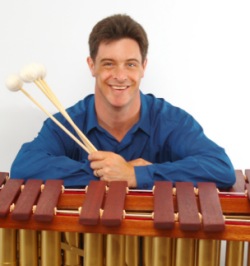
Jim McCarthy, Author, percussionist and instrument builder shown with one of his marimba designs
Got Questions?
Want to speak to me LIVE?
Contact me right now with Start Chat
or Voice Call
Firstly, let me introduce myself.
My name is Jim McCarthy, and I’ve been a percussionist for over 20 years.
I’ve always had a passion for building things, but I’d never consider myself a professional at woodworking or trades … I’ve always been a musician first. So you don't at all need to be a professional to sucessfully build this vibraphone.
You don't need to do any of the design work, calculations, or making mistakes - I've already done all that for you!
When I studied for my masters degree I got really into Acoustics and learned all about how these instruments were built – I even made some massive, world record bass marimbas to indulge my hobby...
But these days my goals are much more practical... I design instruments especially for people like you. It started years ago when I built a few instruments to assist my wife in her school music program. You may even have seen these... the Project 1 Box resonated Xylophone, and the Project 2 mini-marimba which many people around the world have already built to save money for their schools, or as fantastic educational gifts for children.
When you get the “Project V” you will have instant access via download, to all the info you need to build this vibraphone yourself, including:
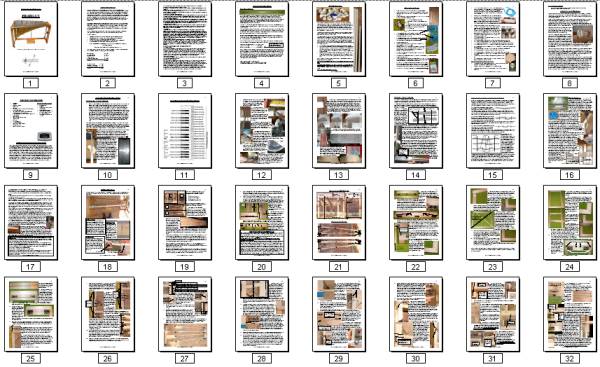
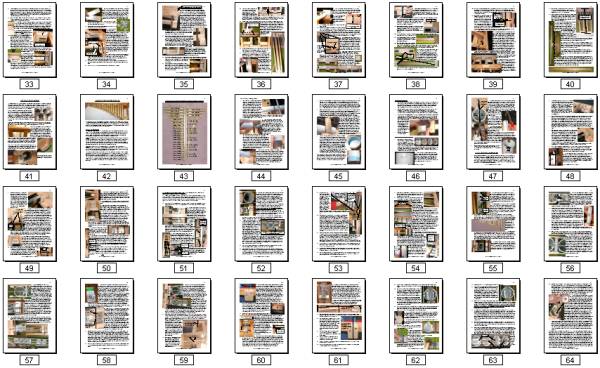
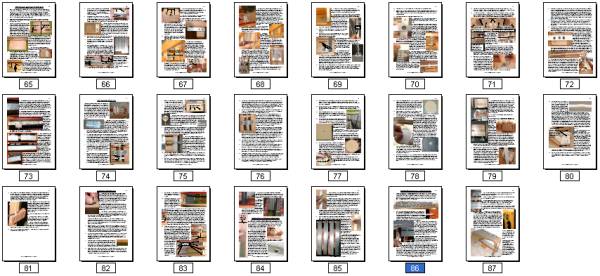
Part 1 - Step by Step Instructions to build this exact instrument. All in an incredibly detailed 87 full size page E-book, this building guide even takes you through theory in case you want to try designing your own modifications.
Your e-book features over 320 Photos and diagrams showing every step of the process in meticulous detail - nothing is left for you to "guess" and there is every piece of information you need.
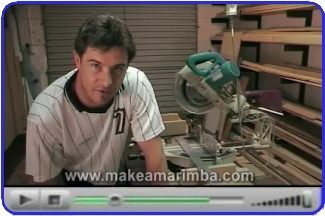
Part 2 - A 38 Minute Video showing you how to cut & tune a vibraphone bar, including fine tuning of the harmonics
Vibraphone Bar Tuning Video
So all the guess work is done for you, and you’ll even have included:
The exact measurements of the bars that work every time - and more than one sizing option, to make working from a variety of standard materials easier.
How to drill and mount the bars in the correct way to ensure that every note sings clearly
How to build the resonating tubes out of easily and readily available materials
How to easily build a cheap, safe & effective motor system for the vibrato effect
How to install a fully adjustable pedal and dampening bar from commonly available materials, which dampens evenly and quietly
How to raise or lower the pitch of the bars by working in the correct places
How to tune the most important harmonics (overtones) on the bars to make them sound pure, tuneful & resonant.
Plus you get these cool FREE Bonuses!
Plus Cool BONUS #1!
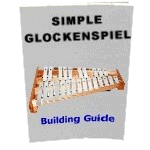
You also get the building guide for this really cool glockenspiel project completely free!
There's no doubt you'll prefer playing on your 3-octave vibraphone, but nothing beats this simple glockenspiel for portability, ease of build and small cost of build. This building guide is not a soft bonus either - it's 23 pages tightly packed with loads of photos and all the details you need for a fantastic result!
Considering you get to build two instruments for the price of one, this bonus makes the whole deal a real no-brainer!
Plus Cool BONUS #2!
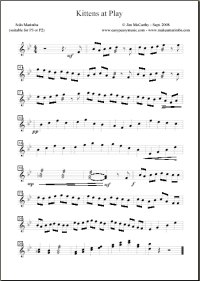
Once you have your instrument finished you will want to play something on it. Sheet music is usually only a few dollars to buy, but it can cost you HEAPS of time finding something suitable for your instrument which is easy to learn and sounds cool. That's why I've written loads of music especially for this instrument - and I'm giving you your first piece completely free!
Having an instrument without music is like having a toy without batteries....
Well when you build THIS instrument, the music is included!
Plus Cool BONUS #3!
Free One Month's subscription to Percussion Keys Website!
This is Definitely for You if you want to learn more about playing & building marimbas, xylophones and other percussion instruments.
You have FULL access to:
The entire "KEYS" video tutorial series, teaching YOU to play marimba & vibes.
Member's forum and Q&A Section.
Monthly Lessons and Videos asked for by YOU, the user.
A Unique library of useful downloads & FAQ for instrument builders and percussionists.
Free sheet music and exercise sheets.
"Cool Videos" of the month.
The retail price of "Percussion Keys" membership is normally $4.95 to set up and just $13.95 per month. BUT... for this one time only as a bonus for purchasing this building guide - you have the option to get that first month's $13.95 free! And of course you have absolutely no obligation to continue your membership past the first month, so you have nothing to lose. Even the tiny $4.95 set up cost is no risk, because it is covered by my 100% money back guarantee. You decide it's not for you...? Then just tell me and I'll give you a full refund.
The great thing about this project is that it will work for you extremely well with standard material which is readily available all over the world. Commercial vibraphones manufacturers often use their own specially blended alloys, and obviously the closer to those alloys you get the more your instrument's sound will match! However I made the prototype bars from less than $200 AUD worth of standard metal stock (T5 Aluminium purchased from a hardware store) and they sound actually better than the commercial bars that they were modeled on.
Some commercial manufacturers use 2024 T4 aluminum and I've built vibraphones with this for a 100% authentic sound. This PV prototype though uses a very standard and common 5000 series aluminium in a basic T5 temper... and it works just fine.... as you can hear for yourself on the video further up this page.
How much will the materials Cost?
The cost of all your materials will depend on where you live. However I purchased absolutely everything I needed (including the bars - see the question above) for less than $700, from my local hardware store.
and the great thing about this design is that it requires no special materials or manufacturing - just standard tools and a good hardware store!
Does the plans include both Metric and Imperial Measurements?
YES! The plans include both imperial (feet and inches) and metric (millimetres) measurements.
Do I need to be good at woodworking to achieve this?
Absolutely not! I’m not a carpenter - I’m a musician. Most of the skills required are fairly basic woodwork – measuring, cutting and sanding.
As long as you can basically use tools like a saw and a drill, I’m confident that you’ll be able to achieve a workable instrument using these plans. Of course I've picked up a few clues over my time designing and building instruments, but I've put all the important construction tips in the package for you.
Do I need lots of expensive tools?
NO - All of the tools you need are commonly available
Here's a list of the essential tools:
A Tape measure & set square
A Hacksaw
An electric drill with drill bits and a sanding attachment
Sandpaper and sanding discs
A screwdriver
A wood saw
A small hammer
Tin snips or tough scissors
Rivet Gun
Plus a few other bits and pieces commonly found around the garage!
Do I need any special tuning equipment?
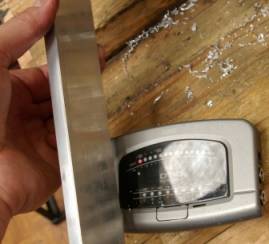
A basic electronic tuner is highly recommended. Any chromatic tuner will do the job, and you can get a really basic electronic tuner from any music store for around $50, or simply borrow one from a friend to get the job done! These tuners are incredibly common – nearly all professional musicians or music teachers either own one or have a friend who owns one.
If you don’t have access to one, don’t worry – as I’ve included a full set of sine waves (clear and clean tones) that you can use to tune the notes by ear. If you have a musical ear it is really easy to do it this way.
Is my homemade instrument going to sound as good as commercially available instruments?
I'm not going to suggest that the instrument YOU build will sound absolutely identical to a commercial instrument... but it is certainly possible to make it incredibly close! If you use the same alloys they use for their bars and be very careful with your tuning... then the sound will be very similar. Even these bars made from standard metal stock, sound great though. In fact I've heard SOME commercial bars which don't sound as good as these DIY ones.
Does it matter what the resonators are made out of?
This is definitely one of the biggest areas of misunderstanding for most people.
The fact is that it makes very little difference!
Comercial instrument manufacturers will often TALK about the sounds of different resonator materials - they want to make their instruments seem more special - BUT have you EVER seen anybody publish an actual audio comparison?
and think about it......The resonator's job is to amplify the sound – and it does this by containing a column of air which is the correct size to resonate when sound waves from the bar enter it.
So... does the column of air really care what is containing it? or does it even know? Remember it’s the column of air that is vibrating.. not the container, so what it's made from really makes very little difference!
and I've heard people argue that certain materials are a little harder and reflect sound better than others - well this is true... but here's the thing...
Extra hard metals etc only make a difference at quite high frequencies - the frequencies way above the range of the vibraphone. Only the upper harmonics of the vibraphone are in this frequency range - and guess what... these upper harmonics are actually tuned to NOT resonate in the tubes!!!
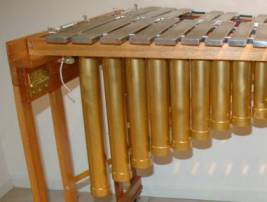
The plans included for this instrument use PVC pipe for the resonators because:
They are lightweight
They are inexpensive
They are easy to work with
They don’t require heavy duty hardware to hold them in place
And you can get PVC pipe at just about any hardware store, as it is usually used for drainpipes around just about any home! Of course - if you really want to use different materials for your resonators, there's absolutely nothing stopping you. The building guide still tells you how to get the result you are after.
Do I have to wait for anything to be shipped to me?
Absolutely not! You have instant access to the e-book and videos via download, so you can get started immediately. The plans print out in Adobe Acrobat Reader (which is a free download, and nearly every computer already has it installed anyway).
Can I modify these plans for different bar sizes or other customizations?
Yes of course you can. There is more than one standard bar sizing and spacing described that you can use depending on what bar stock you have available locally. The whole building process used in this project, AND the building guide itself is actually designed to be as flexible as possible. You can simply follow it exactly - step by step of course... But all the methods of obtaining measurements etc, are explained in detail so you can make your own modifications with confidence if you so desire.
How Much do these plans Cost?
Your PV Vibraphone building guide is just $64.95 US Dollars. You can go to www.xe.com and check it out in your currency.
and this is actually a tiny price for the plans when you consider:
The length of time that I had to study acoustics in order to bring these plans to you
The massive content - 87 A4 sized pages packed with detail including over 320 photos and diagrams AND the 38 minute video going through the bar tuning process step by careful step.
The trial and error that I went through in designing frames, tuning bars and resonators and selecting materials, that you don’t have to!
The money you will save on your instrument - even just the money you will save on wasted materials by NOT making the mistakes that I've already made FOR you!
The near impossibility of finding this information out through other sources – I scoured books and the internet for AGES – and the information you need to build a proper vibraphone yourself is simply not available anywhere but here.
When you click on the order link below on this page, you will instantly have download access to the plans for this Three Octave Vibraphone, and can start building immediately...
But before you do I want you know know something really important....
Your 100% Money Back You have 56 days so that you can fully try out the product!
It took me nearly ten years to build up the skills to effectively tune bars and design instruments that worked, and this prototype has even been on tour with me and stood the test of rugged use. That’s how I know these plans work.
Obviously I can’t build the instrument for you, and your success is going to be determined by a little bit of your own efforts.
If however, you feel that my plans are at fault and they don’t work for you then simply contact clickbank within 56 days for a full refund of the purchase price of this building guide – no questions asked. In fact I insist! I don't want your money if you can't successfully use them to make your own instruments.
And remember that you don't even have to do it yourself...
...you can easily give the plans to an enthusiastic wood-worker to do as a project, or you can even use it as a school class project!
So... You won't regret it, and this will be one investment that could save you money!
Got Questions?
Want to speak to me LIVE?
Contact me right now with Start Chat
or Voice Call
See you on the next page!
Jim McCarthy
P.S. There's no gimmicks here - just real information that you won't find anywhere else!
P.P.S. This is the Perfect solution for YOU if you want a professional instrument for way less than the commercial price - and also have heaps of fun creating a conversation piece for your home!
P.P.P.S. As well as my bulletproof 100% satisfaction money back guarantee - I will PERSONALLY support you in your vibraphone building project. you can simply email with any questions you might have during the project, and I will respond quickly with a detailed answer.
The informational products available at makeamarimba.com and buildavibraphone.com are designed to give the user all the information required to build the corresponding instruments to the same level and finish as the original prototypes pictured on the websites. The final results produced by the end user are naturally dependent partially on their own abilities and efforts. Some of the skills and techniques described in the building guides may require the end user to practise a little before a high proficiency is achieved. This is an expected part of the building process. Once these skills are sufficiently achieved however, the end user if using due care, should be able to build an instrument for a significantly lower cost than that of any commercially equivalent model.









 but this is a quality instrument, and the design is such that you can build it with fairly basic and common tools, using only stuff from the hardware store... and even a relatively inexperienced person in the workshop can build it!


 You also get the building guide for this really cool glockenspiel project completely free!
 Once you have your instrument finished you will want to play something on it. Sheet music is usually only a few dollars to buy, but it can cost you HEAPS of time finding something suitable for your instrument which is easy to learn and sounds cool. That's why I've written loads of music especially for this instrument - and I'm giving you your first piece completely free!